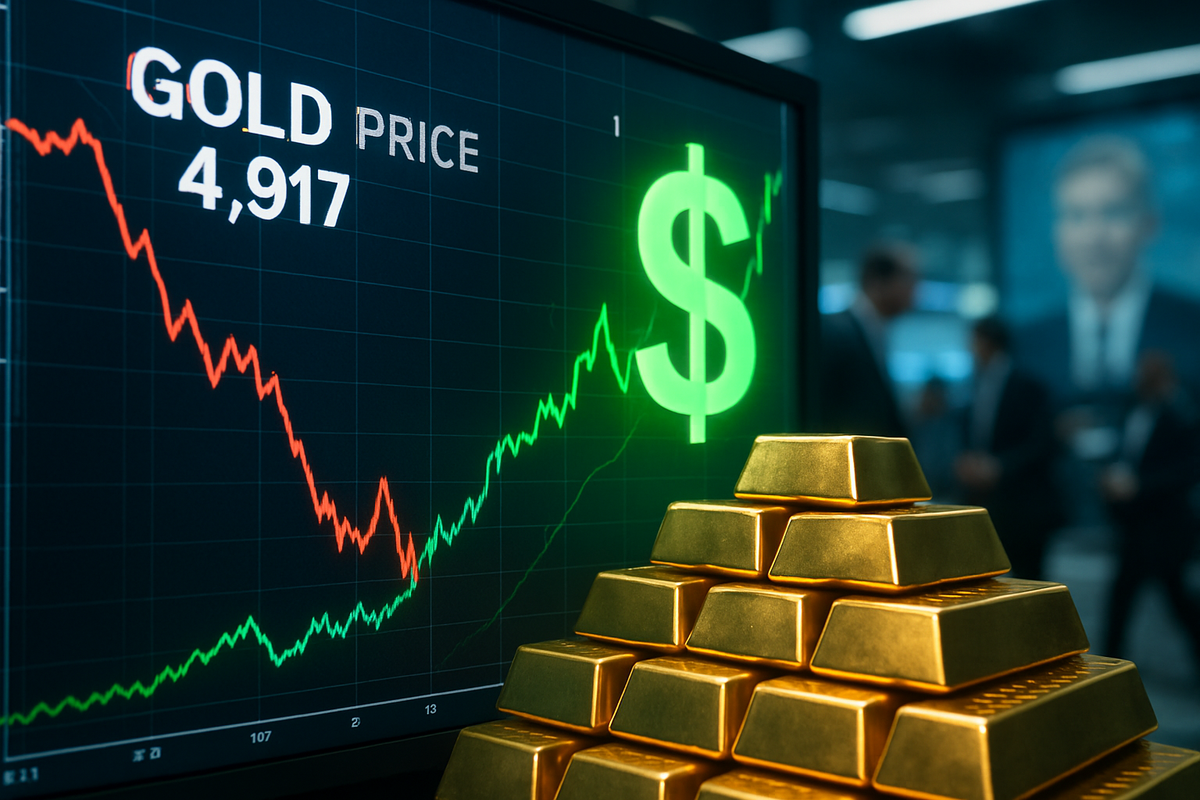
The global gold market witnessed a sharp correction today, with spot prices tumbling 3.5%—a decline of approximately $100—to settle near the $4,917 per ounce mark. This sudden retreat follows a period of historic, almost parabolic growth that saw the precious metal scale heights once thought unreachable. However, the psychological threshold of $5,000 has proven difficult to maintain as a strengthening U.S. dollar and a seismic shift in Federal Reserve leadership expectations fundamentally alter the investment landscape.
The immediate catalyst for this sell-off is the intensifying "Warsh Effect," referring to the market’s aggressive repricing of monetary policy following the nomination of Kevin Warsh as the next Chair of the Federal Reserve. As investors grapple with the transition from the relatively dovish era of Jerome Powell to a potentially more hawkish, "hard-money" regime under Warsh, the "debasement trade"—which propelled gold to nearly $5,600 just weeks ago—is being rapidly unwound. This volatility is forcing a high-stakes re-evaluation of gold’s role as both an inflation hedge and a safe-haven asset.
Policy Shift and the Rise of the "Hawk"
The current decline to $4,917 per ounce represents the second major leg of a correction that began in late January. After hitting an all-time intraday high of approximately $5,594 on January 29, 2026, gold suffered a "flash crash" on January 30 immediately following President Trump’s announcement of Kevin Warsh as his pick to lead the central bank. Prices bottomed near $4,403 on February 2 before staging a tentative recovery that saw the metal briefly reclaim the $5,000 level yesterday. However, that recovery proved short-lived as the U.S. Dollar Index (DXY) climbed to a two-week high of 97.81 today, making the dollar-denominated metal more expensive for international buyers and triggering a fresh wave of profit-taking.
Kevin Warsh, a former Federal Reserve Governor known for his critical stance on the Fed’s massive balance sheet expansion and post-2008 accommodative policies, is viewed by many on Wall Street as a monetary hawk. His nomination signals a departure from the "lower for longer" interest rate philosophy, with markets now pricing in a more aggressive stance on inflation control and quantitative tightening. Stakeholders across the financial spectrum—from central banks in emerging markets to retail investors in the U.S.—are reacting to a future where the Federal Reserve prioritizes a "stable dollar" over market liquidity, a shift that has historically been a significant headwind for non-yielding assets like gold.
Mining Giants and Royalties Under Pressure
The volatility has sent shockwaves through the mining and precious metals sector. Major producers like Newmont Corporation (NYSE: NEM) have seen their market caps under pressure, with Newmont’s stock falling approximately 10% over the last week despite maintaining healthy operational margins. Similarly, Barrick Gold (NYSE: GOLD) has struggled to find a floor, even as its All-In Sustaining Costs (AISC) remain significantly below current spot prices, ensuring the company remains highly profitable at $4,900. These companies, which had been the darlings of the market during gold’s run to $5,500, are now being viewed with caution as investors brace for more "hard-money" rhetoric during Warsh's upcoming confirmation hearings.
Royalty and streaming firms, often used as lower-risk proxies for gold prices, have not been spared. Franco-Nevada (NYSE: FNV) saw its shares retreat as the prospect of a sustained dollar rally dampened the outlook for commodity-linked revenues. Conversely, the U.S. dollar’s resurgence has benefited currency-sensitive ETFs and financial institutions that stand to gain from higher interest rates. Investors in the SPDR Gold Shares (NYSE Arca: GLD) have witnessed the largest three-day outflow in over a year, as capital rotates out of "inflation protection" and back into the greenback. Meanwhile, Agnico Eagle Mines (NYSE: AEM) continues to navigate the turbulence, though its stock remains up nearly 90% year-over-year, illustrating that while the recent drop is painful, the long-term trend for gold remains significantly elevated compared to 2024 levels.
Historical Precedents and the Global Ripple Effect
This event fits into a broader industry trend of "normalization" after a period of extreme geopolitical and fiscal uncertainty. For much of 2025, gold was driven higher by fears of sovereign debt crises and the weaponization of the dollar. The pivot toward Kevin Warsh suggests a strategic move by the administration to restore the dollar’s status as a primary store of value. This transition has historical precedents, most notably the "Volcker Shock" of the early 1980s, where aggressive interest rate hikes were used to break the back of inflation, eventually leading to a multi-year bear market in precious metals.
The ripple effects are likely to be felt across the globe. Central banks, particularly in the BRICS nations, which have been aggressive buyers of gold to diversify away from the dollar, may slow their purchases if the U.S. currency maintains its newfound strength. Furthermore, the regulatory implications of a Warsh-led Fed could include stricter oversight of bank reserves and a reduction in the "Fed put," the long-held belief that the central bank will always intervene to support equity markets. This "tough love" approach to monetary policy is a radical departure from the last decade, and it is fundamentally challenging the "inflation-forever" thesis that had sustained the gold rally.
Short-Term Jitters vs. Long-Term Strategy
In the short term, markets will be hypersensitive to any public statements from Kevin Warsh or the current Fed leadership during the transition period leading up to May 2026. If confirmation hearings reinforce his hawkish reputation, gold could see a test of the $4,400 support level again. However, if the U.S. economy shows signs of slowing under the weight of a stronger dollar and higher rates, safe-haven demand could return, providing a floor for the metal. Strategic pivots will be required for mining companies, which may shift focus from aggressive expansion to debt reduction and shareholder returns to maintain attractiveness in a "high-rate" environment.
Longer-term, the market faces two distinct scenarios. In the first, Warsh successfully stabilizes the dollar and reduces inflation expectations, leading to a period of "disinflationary growth" where gold loses its luster. In the second, the aggressive tightening leads to a "hard landing" for the economy, which would ironically reignite safe-haven demand for gold despite a strong dollar. Investors should watch for the March Fed meeting and any shifts in the "dot plot" forecasts, as these will provide the first concrete evidence of how the central bank’s professional staff is adjusting to the prospect of a new, more hawkish leader.
Conclusion: A New Era for Precious Metals
The drop to $4,917 marks a pivotal moment for the gold market, ending the era of "easy gains" driven by a weakening dollar and fiscal profligacy. The "Warsh Effect" has successfully introduced two-way risk back into a market that had become dangerously one-sided. While gold remains at historically high levels, the 15% correction from January’s peaks serves as a stark reminder that even the ultimate safe haven is not immune to the gravity of U.S. monetary policy.
Moving forward, the primary metric for investors will be the real interest rate—the nominal rate minus inflation. If Kevin Warsh can push real rates significantly into positive territory, the opportunity cost of holding gold will continue to rise. For now, the market is in a "wait-and-see" mode, with the $5,000 level acting as a formidable ceiling. In the coming months, the focus will shift from the drama of the nomination to the reality of policy implementation, and gold’s performance will be the ultimate barometer of the market's faith in the new Federal Reserve regime.
This content is intended for informational purposes only and is not financial advice.