NEW YORK — Omnicom Group Inc. (NYSE: OMC) sent shockwaves through the advertising world this quarter, reporting a gargantuan revenue figure that shattered analyst expectations but failed to deliver the bottom-line precision investors had craved. As the marketing giant navigates the early stages of its historic consolidation with Interpublic Group, the fourth-quarter results highlight a company in profound transition: achieving unprecedented scale while grappling with the friction of merging two of the industry's most complex architectures.
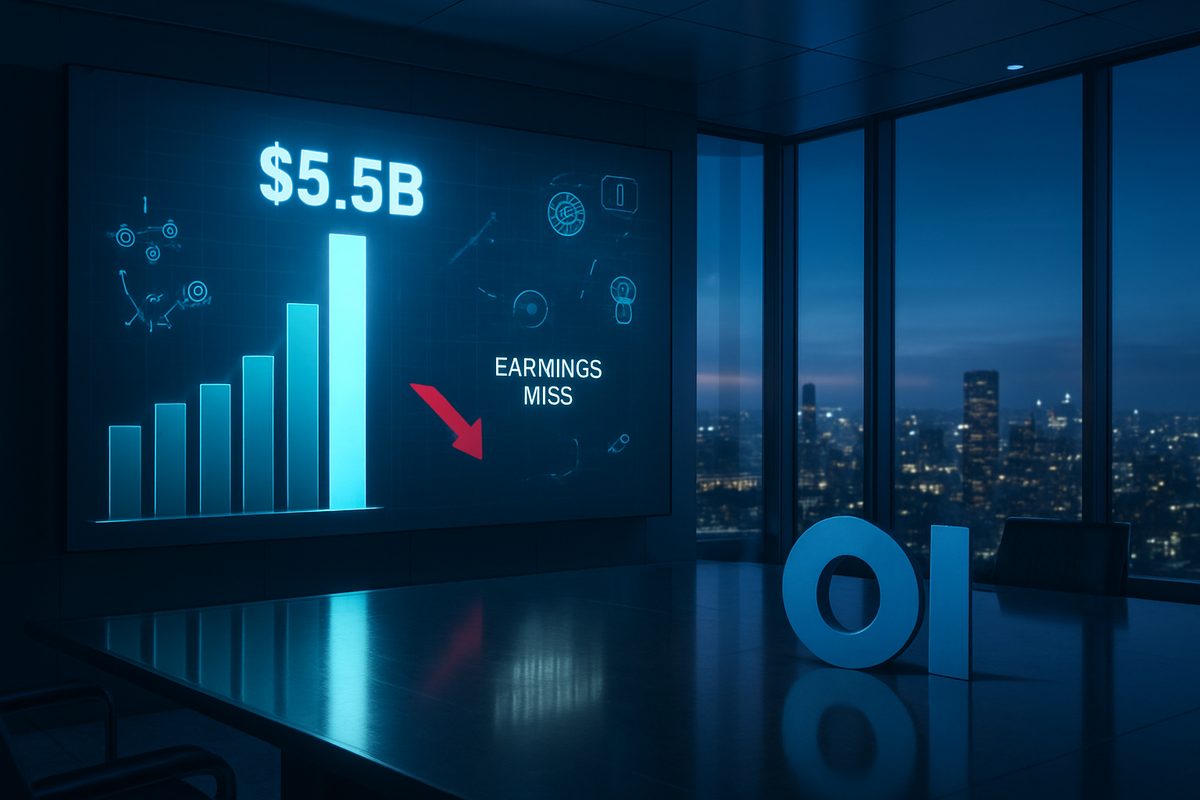
The market reaction was immediate and cautious, with shares of Omnicom trading lower as Wall Street parsed the "noisy" nature of the report. While the top-line surge to $5.5 billion signals a dominant market position, the slight miss on adjusted earnings per share (EPS) and a heavy GAAP loss—driven by over $1 billion in restructuring and acquisition charges—have left investors questioning how quickly the promised synergies of the "new Omnicom" will actually hit the ledger.
The Cost of Consolidation: Breaking Down the Q4 Numbers
Omnicom reported fourth-quarter revenue of $5.5 billion, a staggering figure that comfortably cruised past the $4.52 billion consensus estimate. This 27.9% year-over-year increase was largely powered by the first full month of integrated operations following its acquisition of Interpublic Group (IPG), which closed on November 26, 2025. However, the sheer volume of business did not immediately translate to profit. Adjusted EPS came in at $2.59, narrowly missing the $2.61 analyst target and falling well short of some more optimistic internal models that had expected quicker efficiency gains.
The timeline leading to this moment has been one of the most watched narratives in corporate services. After announcing the merger in mid-2025, CEO John Wren has been under intense pressure to prove that "bigger is better" in an era dominated by tech platforms. The Q4 results revealed the heavy lifting required to reach that goal: the company took a $1.1 billion charge for restructuring and severance as it began the painful process of realigning the combined workforce. Furthermore, the assumption of approximately $3 billion in IPG debt led to a spike in interest expenses, further squeezing the adjusted margins.
Initial industry reactions have been polarized. While some analysts pointed to the $5.5 billion revenue as a sign of robust organic demand across the "Connected Capability" model, others focused on the $543 million loss on the planned sale of non-core assets. These "dispositions" are part of a regulatory-mandated diet, with Omnicom expected to shed nearly $2.5 billion in annual revenue to satisfy antitrust concerns and strategic streamlining. For now, the complexity of these moving parts has kept the stock under pressure as the market waits for a cleaner quarter.
Winners and Losers in the New Advertising Hierarchy
In the wake of Omnicom's mixed results, the competitive landscape of the advertising world is being redrawn. Publicis Groupe (OTC: PUBGY) stands out as the primary beneficiary of the current volatility. While Omnicom is bogged down in integration, Publicis reported 5.9% organic growth and industry-leading margins of over 18%. By having completed its own data-centric transformation years ago with the Epsilon acquisition, Publicis is currently viewed by many investors as the "cleaner" play for those wanting exposure to ad-tech without the merger-related noise.
Conversely, WPP (NYSE: WPP) continues to struggle in the shadow of its larger rivals. Reporting a difficult fiscal year with significant profit drops, WPP has been forced to launch its "Elevate28" strategy to simplify its own sprawling structure. As Omnicom and IPG unite to form a defensive wall of scale, WPP finds itself caught in the middle—lacking the pure-play data margins of Publicis and the massive consolidated volume of the new Omnicom. Smaller, independent agencies may also find a "winning" window here, as talent and clients who are wary of the culture shifts at a consolidated Omnicom-IPG may seek more boutique alternatives.
For the clients—the Fortune 500 brands that fuel these agencies—the results are a double-edged sword. On one hand, Omnicom’s massive scale offers unparalleled buying power in the media markets. On the other, the "light" earnings and heavy restructuring suggest that the agency's internal focus may be diverted toward integration rather than creative innovation in the short term. Competitors like The Trade Desk (NASDAQ: TTD) and Accenture Song (NYSE: ACN) are lurking, ready to peel off digital-first budgets if the legacy holding companies stumble during their metamorphosis.
The "Algorithmic Era" and the $1 Trillion Milestone
This financial event sits at the epicenter of a broader transformation in the global marketing sector. As of early 2026, global ad spend is projected to surpass the $1 trillion mark for the first time in history. This milestone is being driven not by traditional television or print, but by "agentic commerce" and Retail Media, which is growing at a 14% clip. Omnicom’s move to acquire IPG was a strategic bet that scale is the only way to compete with the "walled gardens" of Google and Meta in this new algorithmic era.
The shift from AI as a "creative tool" to AI as an "operational engine" is the silent driver behind Omnicom’s restructuring charges. The company is aggressively moving to automate campaign management and real-time bidding, a transition that requires fewer traditional middle-management roles and more high-cost data scientists. This historical precedent mirrors the consolidation seen in the telecommunications and banking sectors a decade ago—where the middle ground disappeared, leaving only massive, tech-integrated giants and small, specialized boutiques.
Furthermore, the regulatory landscape is shifting. The loss Omnicom took on asset dispositions highlights the increased scrutiny on "mega-mergers" in the services sector. As the company sheds non-core assets to satisfy regulators, it is effectively defining the limits of horizontal integration. The ripple effects will likely discourage similar-sized mergers in the near term, as competitors watch to see if Omnicom can successfully digest IPG without losing its creative soul or its top-tier talent.
Navigating the Integration Maze: What Comes Next?
In the short term, Omnicom must provide clarity on its "synergy" roadmap. CEO John Wren has recently signaled an aggressive pivot, doubling projected annual cost synergies to $1.5 billion, with nearly $900 million expected to be realized by the end of 2026. If the company can hit these targets, the "light" earnings of Q4 2025 will be viewed as a mere speed bump. However, if integration friction persists—particularly in merging the distinct cultures of agencies like McCann and BBDO—the stock could face a prolonged period of underperformance.
The long-term outlook depends on Omnicom's ability to leverage its new "Identity Infrastructure." By combining the data sets of both holding companies, Omnicom aims to create a proprietary alternative to the cookie-less tracking world. This strategic pivot requires significant capital expenditure, which may keep margins thin through the first half of 2026. Investors should look for "capability-led" growth in areas like Connected TV (CTV) and personalized AI-generated content as signs that the strategy is bearing fruit.
Market opportunities may also emerge from the company's planned $2.5 billion Accelerated Share Repurchase (ASR) program. By aggressively buying back its own stock, Omnicom is signaling confidence that its current valuation does not reflect its future earnings power once the IPG integration is "clean." However, the challenge remains: Omnicom must prove it can be both a giant and an athlete, maintaining the agility to respond to rapid shifts in consumer behavior while managing a workforce of over 150,000 employees.
Summary: A Giant in Transition
The fourth-quarter earnings report from Omnicom serves as a vivid illustration of the "growing pains" inherent in industry-defining mergers. While the $5.5 billion revenue beat confirms that the company has successfully captured a massive slice of the global marketing pie, the EPS miss reminds the market that scale often comes at a temporary cost to efficiency. The "noisy" results are a byproduct of a company fundamentally rebuilding itself for an AI-dominated future.
Moving forward, the market will likely remain skeptical until Omnicom can deliver a quarter free of "one-time" restructuring charges and disposition losses. The key takeaways for investors are clear: watch the synergy realization rates, monitor the organic growth of Publicis as a benchmark for what "clean" success looks like, and keep a close eye on client retention during the ongoing integration process.
The next six months will be a defining period for Omnicom. If the company can successfully translate its massive top-line presence into the $1.5 billion in promised synergies, it will have created a nearly unassailable fortress in the advertising world. For now, however, it remains a giant in transition, asking for investor patience while it finishes the difficult work of building the future of marketing.
Financial Post Reporting March 12, 2026
This content is intended for informational purposes only and is not financial advice.