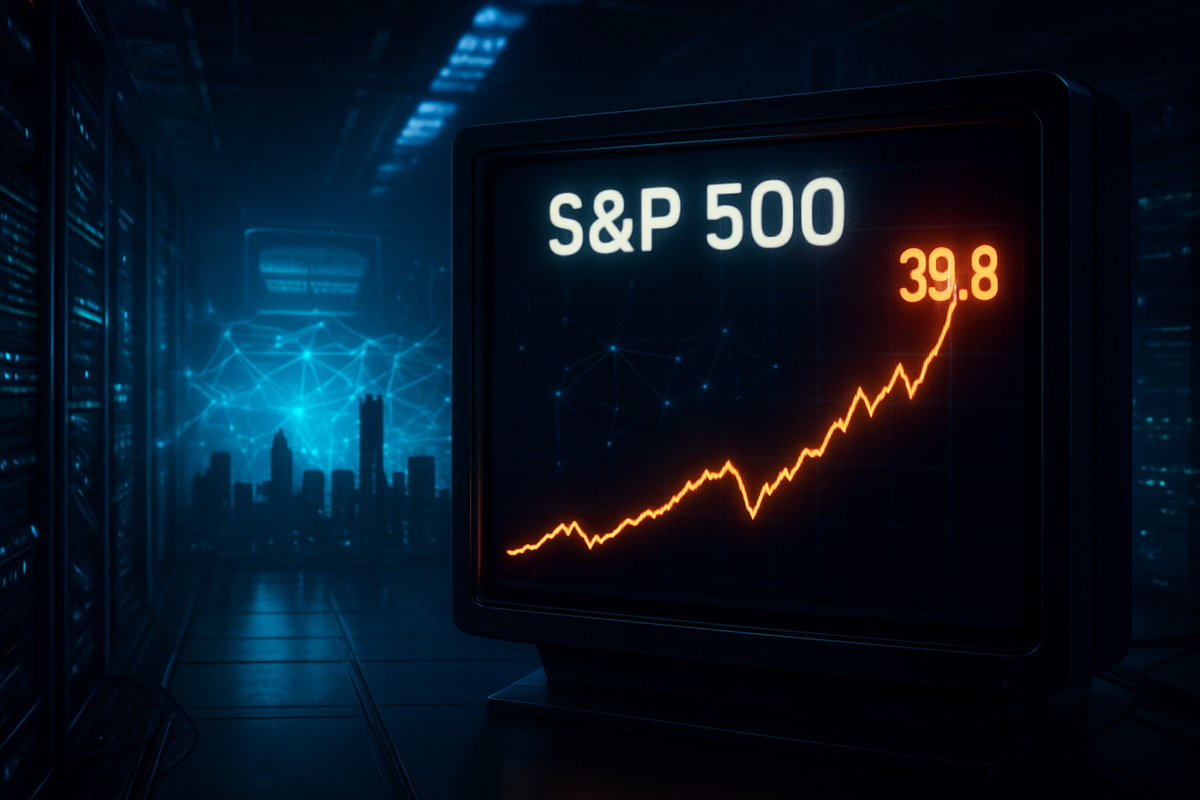
The S&P 500 reached a critical psychological and technical threshold on March 9, 2026, as the Cyclically Adjusted Price-to-Earnings (CAPE) ratio—often referred to as the Shiller P/E—climbed to 39.8. This milestone marks the most expensive valuation for the broad market index since the height of the dot-com bubble in 2000, when the ratio peaked at 44.19. The surge comes amidst a relentless rally driven by the "Hyper-Capex" cycle of the past 18 months, leaving investors to weigh the promise of a productivity revolution against the stark reality of historical overextension.
The immediate implications of this valuation alarm are being felt across global trading floors. As the S&P 500 hovers at these rarified levels, the market's internal architecture has become increasingly fragile. A staggering one-third of total U.S. GDP growth is now directly linked to artificial intelligence infrastructure and spending. While this has provided a robust floor for economic expansion, it has also created a "valuation trap" where even minor misses in earnings or a slowdown in chip procurement could trigger a systemic deleveraging event.
The Road to 39.8: A Timeline of the AI-Driven Supercycle
The journey to this morning’s valuation peak began in late 2024, when the S&P 500 first crossed the 30.0 CAPE threshold. Throughout 2025, the market defied traditional gravity, propelled by massive capital expenditures from the "Hyperscalers"—Microsoft Corporation (NASDAQ: MSFT), Alphabet Inc. (NASDAQ: GOOGL), Amazon.com, Inc. (NASDAQ: AMZN), and Meta Platforms, Inc. (NASDAQ: META). These four entities alone committed an estimated $530 billion to AI infrastructure in the last calendar year, a figure that has fundamentally reshaped the U.S. economic landscape.
By the third quarter of 2025, the Federal Reserve Bank of St. Louis reported that AI-related investments accounted for nearly 40% of the marginal growth in U.S. GDP. This "AI-as-GDP" narrative fueled a second wave of the bull market, moving beyond chipmakers and into the power, cooling, and real estate sectors. However, as we enter March 2026, the sentiment is shifting. The rally has become increasingly concentrated, with the top 10 stocks in the S&P 500 now representing over 35% of the total index weight, surpassing the concentration levels seen during the 1929 and 2000 crashes.
Key stakeholders, including institutional asset managers and pension funds, are now expressing "valuation fatigue." On the morning of March 9, several high-profile analysts from firms like Goldman Sachs and Morgan Stanley issued notes highlighting the "Nvidia Paradox"—a phenomenon where even stellar earnings growth from companies like NVIDIA Corporation (NASDAQ: NVDA) can no longer compress the overall market multiple. The market has priced in "perfection" through the end of the decade, leaving zero margin for error in the execution of AI monetization.
Winners and Losers in the High-Stakes Valuation Game
The current valuation climate has created a sharp divergence between the "infrastructure providers" and the "application layer." The clear winners of the early 2026 environment remain the hardware and memory giants. Micron Technology, Inc. (NASDAQ: MU), for instance, has seen its revenue nearly double year-over-year as the "memory supercycle" for High Bandwidth Memory (HBM) shows no signs of slowing. Similarly, Oracle Corporation (NASDAQ: ORCL), which reported earnings this morning, continues to benefit from its "Stargate" AI project, boasting a backlog that has grown fourfold since early 2025.
Conversely, the "losers" in this valuation reckoning are the legacy software firms and consulting giants struggling with "seat compression." Adobe Inc. (NASDAQ: ADBE), also reporting this week, has faced significant downward pressure as investors fear that autonomous AI agents are cannibalizing its core creative seat-based revenue. Shares of Adobe have shed over 25% year-to-date as the market re-rates the entire Software-as-a-Service (SaaS) sector from a growth-oriented 40x multiple down to a more modest 20x.
Broadcom Inc. (NASDAQ: AVGO) and CrowdStrike Holdings, Inc. (NASDAQ: CRWD) represent the middle ground—companies that are beating earnings expectations but seeing their stock prices stagnate or fall. This "sell-the-news" behavior on positive results suggests that the market’s appetite for "potential" has been replaced by a demand for "hard ROI." For these companies, the challenge is no longer about proving the technology works, but proving that it can expand margins in an increasingly expensive capital environment.
Historical Precedents and the AI-GDP Nexus
Comparing the current 39.8 CAPE ratio to the dot-com era reveals both chilling similarities and distinct differences. In 2000, the market was fueled by speculative internet startups with little to no revenue. In 2026, the rally is backed by some of the most profitable companies in history, generating hundreds of billions in free cash flow. However, the concentration risk is actually higher today than it was in 2000. The systemic reliance on AI spending to drive 1/3 of GDP growth means that any disruption in the silicon supply chain or a pivot in corporate AI strategy could have a far more profound impact on the real economy than the fiber-optic glut of the early 2000s.
This event also highlights a broader shift in industry trends toward "sovereign AI" and heavy industrial policy. Regulatory bodies in the U.S. and EU are closely watching the concentration of compute power, with potential antitrust implications for the Hyperscalers. If the "AI-GDP" link continues to tighten, we may see AI infrastructure treated more like a public utility, leading to a regulatory environment that could cap the high-margin "software-like" returns investors have grown accustomed to.
Furthermore, the "SaaSpocalypse" of early 2026 mirrors the "client-server" transition of the early 1990s. While total economic output increased during that transition, many dominant players of the previous era were left behind. The current valuation alarm suggests that the market is beginning to realize that while AI is a net positive for GDP, it may be a net negative for the profit margins of legacy software providers who are seeing their "billable hours" or "user seats" replaced by highly efficient, autonomous agents.
What Comes Next: The Path Toward a Soft Landing or a Hard Reset
In the short term, the market is likely to experience heightened volatility as it prepares for the Federal Reserve’s next move. With AI spending keeping GDP growth at a robust 2.8%, the Fed may be forced to keep interest rates "higher for longer" to combat persistent inflation in the tech and energy sectors. This creates a double-edged sword: strong economic growth justifies high valuations, but high interest rates make the "cost of carry" for these expensive multiples increasingly difficult for institutional investors to justify.
Strategic pivots are already underway. We expect to see a shift from "Hyper-Capex" to "Operational Efficiency" in the second half of 2026. Companies that cannot demonstrate a clear path to AI monetization beyond infrastructure build-outs will likely see their valuations continue to compress. The "AI Revenue Gap"—the difference between what is being spent on chips and what is being earned from AI services—must begin to close by the end of the year to prevent a more significant market correction.
A potential "soft landing" remains possible if the productivity gains from AI begin to manifest in non-tech sectors like healthcare and manufacturing. If AI can drive a broad-based increase in corporate margins across the remaining 490 companies of the S&P 500, the index could grow into its current valuation. However, if the "AI ROI" remains elusive, the risk of a "hard reset" back toward the historical CAPE mean of 28.0—representing a potential 30% downside—remains a looming threat for 2027.
Final Assessment: Navigating a Market Priced for Perfection
The S&P 500's reach toward a 39.8 CAPE ratio is more than just a statistical anomaly; it is a signal that the market has reached the limits of "speculative growth." While the integration of AI into 1/3 of the U.S. GDP growth provides a solid fundamental backdrop, the concentration of that growth into a handful of tech giants has created a top-heavy index that is vulnerable to even the slightest shift in sentiment or policy. Investors are no longer buying "the future"—they are buying a future that has already been meticulously modeled and priced to the cent.
Moving forward, the market will likely move away from "momentum-based" tech investing and toward "quality-at-a-reasonable-price" (GARP). The "Nvidia Paradox" has taught us that even record-breaking growth is not enough when valuations are untethered from historical norms. The coming months will be a "reckoning for the application layer," as companies like Adobe and Salesforce are forced to prove their relevance in an agent-led economy.
For the remainder of 2026, investors should keep a close eye on the "Capex-to-Revenue" ratios of the Hyperscalers and the quarterly guidance of the memory and chip manufacturers. The alarm has been raised; whether the market heeds the warning or continues its climb toward the 2000 peak of 44.19 will depend entirely on whether AI can transition from an expensive infrastructure project into a sustainable engine of corporate profit.
This content is intended for informational purposes only and is not financial advice.