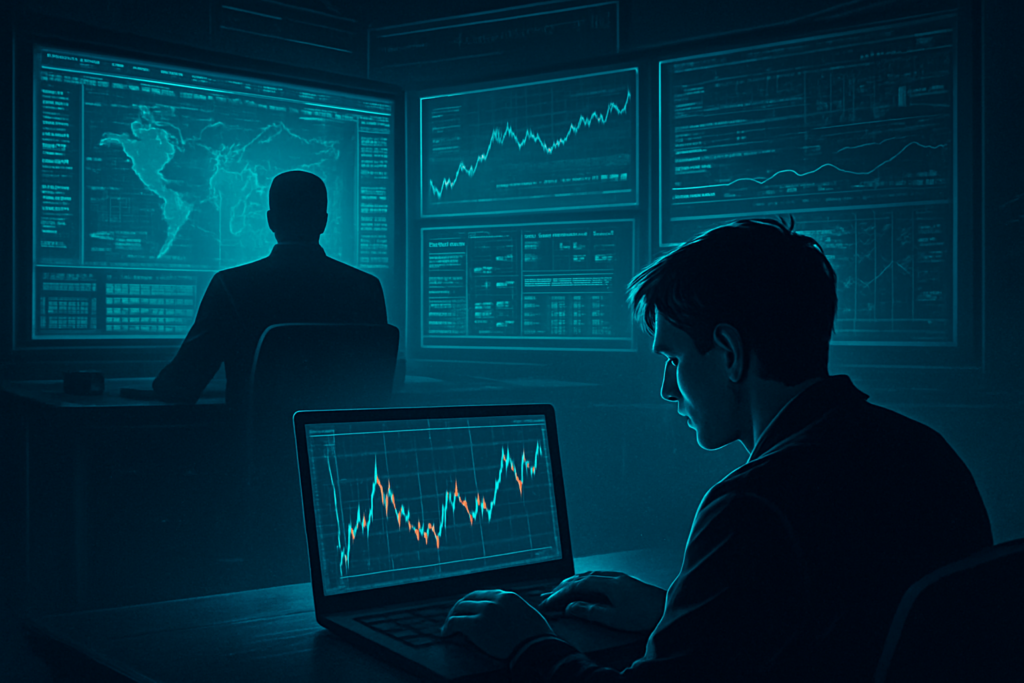
In the high-stakes arena of global prediction markets, where fortunes are made and lost on the blink of a headline, a new and sobering narrative is taking hold. As of January 15, 2026, the meteoric rise of platforms like Polymarket has turned prediction trading into a multi-billion dollar industry. However, a growing chorus of analysts is warning that the "wisdom of the crowd" may actually be a sophisticated trap for the unwary.
Leading this charge is the prominent, albeit pseudonymous, market analyst known as 'DANNY', whose recent report, "99% Will Lose Everything," has sent shockwaves through the trading community. DANNY’s thesis is simple but devastating: the vast majority of retail participants are not trading against the "crowd," but are instead serving as "exit liquidity" for a class of data-rich insiders and professional "Information Whales" who move prices long before the general public even sees the news.
The Market: What's Being Predicted
While prediction markets technically allow users to bet on everything from Federal Reserve interest rate hikes to the winners of the 2026 midterm elections, the real "market" currently under scrutiny is the integrity of the platforms themselves. Polymarket, the decentralized heavyweight in the space, has recently seen its legitimacy challenged by a landmark study from Columbia University.
The study, published in late 2025, utilized a network-based algorithm to trace linked wallet addresses. The findings were staggering: approximately 25% of Polymarket’s total historical volume was identified as wash trading—the act of traders buying and selling to themselves to create a false appearance of high liquidity and interest. In specific high-volatility sectors like sports and global geopolitical events, that figure reportedly spiked to over 45%.
Currently, the odds on many major contracts are shifting wildly, but analysts like DANNY argue these are "ghost signals." On Polymarket, where volume often reaches hundreds of millions of dollars per week, the "liquidity" that retail traders rely on to enter and exit positions is often an artificial construct designed to lure in small-time bettors. This creates a dangerous environment where price movements do not represent actual sentiment change, but rather a coordinated manipulation of the order book.
Why Traders Are Betting
Despite these warnings, the allure of the "big win" remains stronger than ever. Retail traders are often driven by the success stories of "whales" who seem to possess a prophetic ability to time the market. A notable example frequently cited by DANNY is the trader nicknamed "Alpha Raccoon," who reportedly netted over $1.5 million by predicting Alphabet Inc. (NASDAQ: GOOGL) Year in Search results hours before they were made public.
Similarly, the capture of Venezuelan leader Nicolás Maduro in early January 2026 saw a single anonymous wallet pocket over $400,000 in a matter of hours. These events drive a massive FOMO (Fear Of Missing Out) among retail participants who believe they can catch the next "alpha" signal.
However, DANNY points out that these are not lucky guesses. "Information Whales" utilize advanced data-scraping tools, real-time news terminals like Bloomberg (Private), and even military-grade intelligence to front-run the market. By the time a retail trader sees a volume spike and decides to jump in, the professional has often already secured the favorable price and is looking for someone to buy their position—the aforementioned "exit liquidity."
Broader Context and Implications
The debate over information asymmetry has sparked a regulatory firestorm in Washington. On January 10, 2026, U.S. Representative Ritchie Torres introduced the Public Integrity in Financial Prediction Markets Act of 2026, which aims to curb the influence of non-public information in these markets. The bill follows a Senate inquiry into offshore platforms that operate outside the purview of the Commodity Futures Trading Commission (CFTC).
The divide between regulated exchanges like Kalshi (Private) and offshore entities like Polymarket is becoming a central theme of the industry. While Kalshi enforces strict anti-insider trading rules for government officials, Polymarket has historically leaned into the philosophy that "insider trading is a feature, not a bug," arguing that it forces information into the price more efficiently.
This "feature," however, comes at a high cost to public trust. If 25% to 60% of signals are faked or front-run, the prediction market loses its value as a tool for public sentiment and becomes a playground for a new era of digital high-frequency manipulation.
What to Watch Next
Traders should keep a close eye on the upcoming regulatory hearings scheduled for late January, where the CFTC is expected to testify regarding the enforcement of wash-trading bans on decentralized protocols. If the "Torres Bill" gains momentum, we could see a massive migration of volume from unregulated platforms to more transparent, audited exchanges.
Furthermore, new "transparency tools" are being developed by third-party blockchain forensic firms to help retail traders identify wash-trading patterns in real-time. Monitoring wallet clusters—where multiple accounts send funds back and forth to create volume—will be a critical skill for any trader hoping to survive in 2026.
The next major test for these markets will be the spring 2026 economic data releases. Watch for sudden, high-volume price shifts that occur minutes before official government reports are published; these are the "smoke" that often precedes the fire of insider activity.
Bottom Line
The rise of prediction markets as a mainstream financial tool is undeniable, but the warnings from analysts like DANNY suggest that the industry is in a "Wild West" phase where the house—and the whales—always have the advantage. For the retail trader, high volume should no longer be seen as a sign of health, but as a signal for extreme caution.
Until platforms implement more robust anti-wash-trading protocols and regulators provide a clearer framework for "fair play," the information gap remains a chasm that few retail participants will successfully cross. As DANNY famously put it in his report, "In a market of information, the person with the fastest cable always wins."
Skepticism, scrutiny of wallet patterns, and a healthy distrust of volume spikes are the only tools retail traders have to avoid becoming the exit liquidity for the next big whale trade.
This article is for informational purposes only and does not constitute financial or betting advice. Prediction market participation may be subject to legal restrictions in your jurisdiction.
PredictStreet focuses on covering the latest developments in prediction markets.
Visit the PredictStreet website at https://www.predictstreet.ai/.