As the NFL post-season enters its most critical stretch, the traditional landscape of sports wagering is facing a paradigm shift. On January 14, 2026, the prediction market industry reached a staggering milestone, processing over $701.7 million in a single day of trading. This record-breaking activity, driven primarily by the high-stakes matchups of the NFL Wild Card and Divisional rounds, marks the first time that decentralized and regulated event contracts have seriously rivaled the "handle" of the world’s largest sportsbooks.
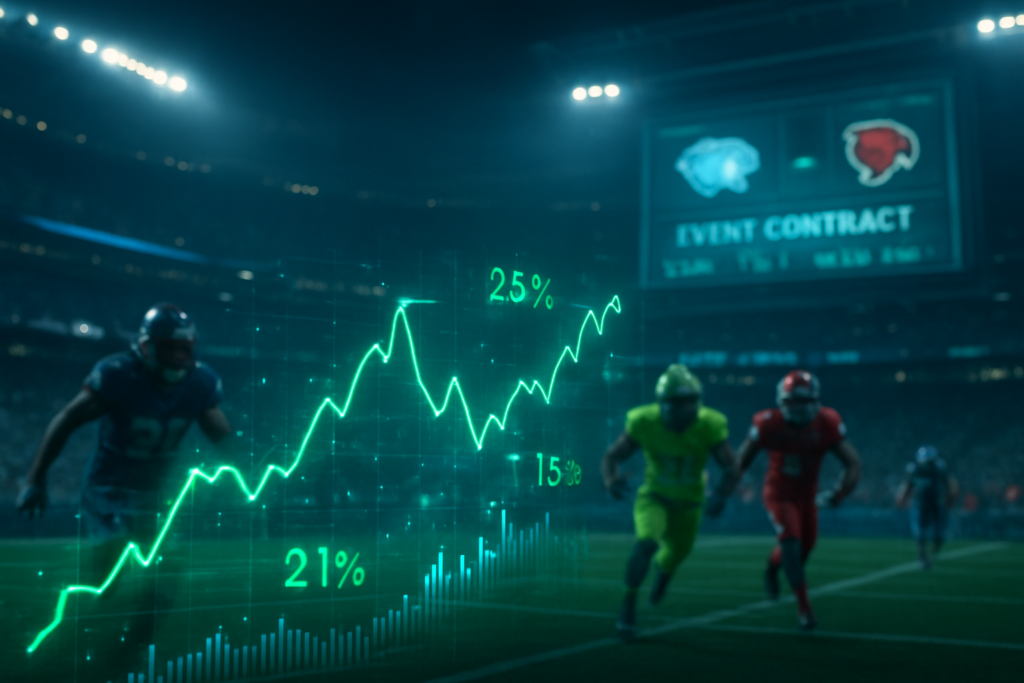
Currently, the markets are pricing the Seattle Seahawks as the frontrunners for Super Bowl LX at a 25% probability, followed closely by the Los Angeles Rams at 21%. Unlike previous years where these figures were merely "odds" set by a bookmaker, these percentages represent live, liquid trades where millions of dollars are moving every hour. The surge in volume is being hailed as the "Information Finance" revolution, as traders move away from the high-fee models of traditional betting toward the transparent, order-book mechanics of prediction platforms.
The Market: What's Being Predicted
The primary focus of the current trading frenzy is the "Super Bowl LX Champion" contract, which has become the most liquid sports market in history. On Polymarket, the global leader in crypto-native prediction volume, the Super Bowl winner market has already surpassed $674.5 million in cumulative volume. Meanwhile, Kalshi, the CFTC-regulated exchange, has seen its volume explode to over $465 million in daily activity, bolstered by its recent integration with retail powerhouse Robinhood (NASDAQ: HOOD).
The current odds reflect a significant shift in sentiment over the last 48 hours. The Buffalo Bills, once a 10% underdog, have climbed to 15% following a dominant performance, while the Philadelphia Eagles have stabilized at 11%. These markets are binary: a contract for a team to win pays out at $1.00 if they take the trophy and $0.00 if they don't. This "yes/no" structure allows for a level of transparency that traditional "plus-minus" odds struggle to match.
The liquidity is no longer limited to the eventual champion. Traders are now actively making markets on micro-events, such as individual player milestones and even specific coaching decisions. Resolution is strictly tied to official NFL data, ensuring that contracts settle within minutes of the game clock hitting zero.
Why Traders Are Betting
The migration from traditional sportsbooks like DraftKings (NASDAQ: DKNG) and FanDuel (NYSE: FLUT) to platforms like Kalshi and Polymarket is largely driven by "the vig"—or rather, the lack of it. Traditional sportsbooks typically bake in a 5% to 10% "juice" or margin into their lines. In contrast, the competitive order-book model of prediction markets has squeezed spreads down to 1% or 2%. For high-volume traders, this price discovery is the difference between a profitable season and a losing one.
"We aren't just betting on a game; we are trading an asset," says one high-frequency trader on the Kalshi platform. "If the Seahawks score an early touchdown, the price of their 'Yes' contract jumps immediately. I can sell my position and take profit before the first quarter is even over. You can't do that with the same efficiency at a traditional book."
Furthermore, the introduction of "Combos"—Kalshi’s regulated answer to the parlay—has attracted the retail audience that previously fueled the growth of MGM Resorts (NYSE: MGM) and its BetMGM platform. By allowing traders to link multiple event outcomes into a single derivative contract, these platforms have successfully captured the speculative "lottery ticket" interest that makes sports betting so popular, but with the added benefit of a transparent secondary market where those positions can be traded in real-time.
Broader Context and Implications
This surge in volume represents more than just a good month for sports fans; it signifies a structural change in how the public consumes information. Major news networks have begun displaying Kalshi and Polymarket probabilities alongside traditional game stats, treating the market price as the "true" probability of an event occurring. This "truth engine" effect has made prediction markets a primary source for sports analysts who previously relied on subjective expert opinions.
However, the rapid growth has not been without friction. State regulators in Nevada and Connecticut have recently challenged the legality of these "sports event contracts," arguing they bypass traditional state-level gambling taxes and oversight. Kalshi maintains that they are an authorized derivatives exchange under the Commodity Exchange Act, setting the stage for a landmark legal battle that could define the future of financialized sports in America.
Historically, prediction markets have shown a remarkable ability to outperform individual "experts." During the 2025 season, the closing prices on Polymarket were more accurate in predicting playoff upsets than the opening lines at major Vegas sportsbooks in 72% of cases.
What to Watch Next
As we approach the Divisional Round this weekend, all eyes are on the liquidity depth for the "Underdog" contracts. A massive "whale" position was recently spotted on Polymarket, with a single trader betting over $2.5 million on the New England Patriots to reach the AFC Championship. If the Patriots pull off an upset, it could trigger a massive "gamma squeeze" style movement in the AFC winner markets.
Key dates to monitor include January 25, the date of the Conference Championships, and February 8, the date of Super Bowl LX. Industry analysts project that the Super Bowl will be the first single-day event in history to see over $1 billion in trading volume across all prediction platforms combined.
Additionally, keep a close watch on the "Robinhood Effect." As more retail investors gain access to these markets through their existing brokerage accounts, the volatility of these contracts is expected to increase, creating opportunities for sophisticated arbitrageurs to capitalize on price discrepancies between the regulated US markets and the international crypto markets.
Bottom Line
The early 2026 NFL Playoffs have proven that prediction markets are no longer a niche corner of the internet for "crypto-bros" and political junkies. They have become a mainstream financial infrastructure that is actively cannibalizing the handle of multi-billion dollar sportsbooks. By offering better prices, more flexibility, and a transparent "order-book" model, these platforms are effectively turning sports fans into sophisticated market participants.
Whether the Seahawks fulfill their 25% promise or a long-shot like the Patriots stages a historic run, the real winner of the 2026 season appears to be the prediction market model itself. As the "vig" continues to shrink and liquidity continues to grow, the line between "betting" on a game and "investing" in an outcome is becoming thinner than ever.
This article is for informational purposes only and does not constitute financial or betting advice. Prediction market participation may be subject to legal restrictions in your jurisdiction.
PredictStreet focuses on covering the latest developments in prediction markets.
Visit the PredictStreet website at https://www.predictstreet.ai/.