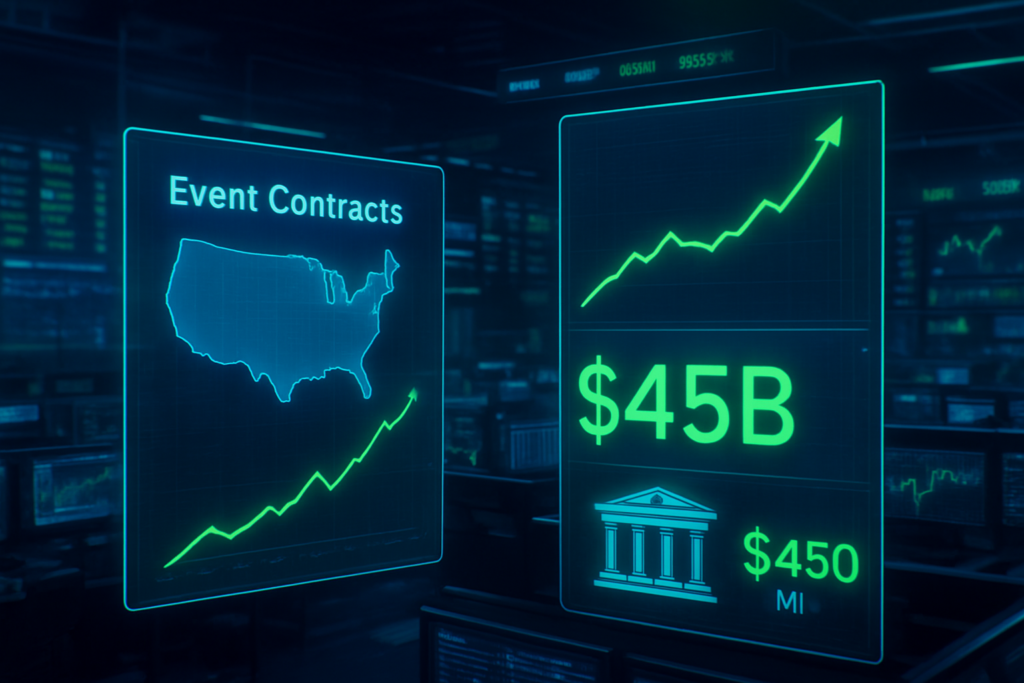
The prediction market industry has officially shed its label as a niche corner of the internet for political junkies and sports bettors. As of early February 2026, the sector is celebrating a watershed moment: total trading volume surpassed a staggering $45 billion in 2025, a nearly five-fold increase from the previous year. This momentum shows no signs of slowing, with February 2026 on track to set a new monthly record for trading activity as retail and institutional investors pour into the space.
At the heart of this explosion is the rise of the "Event Contract," a structured derivative that allows participants to trade directly on the outcome of real-world events. No longer viewed as mere gambling, these contracts have become a standard asset class. The primary driver of this month’s record volume is the Federal Reserve’s interest rate path, where the market for a potential March rate cut has ballooned to over $450 million in open interest. For many, these markets are no longer just a side bet—they are the most accurate real-time indicator of economic reality available.
The Market: From $9 Billion to $45 Billion
The scale of the prediction market industry has undergone a total transformation over the last 24 months. In 2024, the industry aggregate volume sat at approximately $9 billion, largely buoyed by the U.S. presidential election. However, 2025 proved that the appetite for event-based trading was not a one-off phenomenon. Total volumes for 2025 topped $44 billion, led by the regulated U.S. exchange Kalshi and the decentralized giant Polymarket.
Kalshi, the first CFTC-regulated prediction market, saw its 2025 volume soar to $23.8 billion, representing an 1,108% increase year-over-year. Meanwhile, Polymarket, which saw Intercontinental Exchange (NYSE: ICE) take a 20% strategic stake late last year, contributed roughly $21.5 billion to the global total. These platforms have moved beyond political "who-will-win" scenarios into complex macro-economic hedging tools.
Currently, the highest-liquidity market involves the Federal Open Market Committee (FOMC) meeting scheduled for March 17–18, 2026. After the Fed held rates steady at 3.5%–3.75% during their January 28 meeting, the prediction markets are now pricing in a 64% probability of a 25-basis-point cut in March. With nearly half a billion dollars at stake in this single contract, the liquidity now rivals that of traditional interest rate swaps.
Why Traders Are Betting: The Search for "Settlement Certainty"
The migration of capital into event contracts is driven by a fundamental shift in how traders perceive "truth." Unlike traditional equities or commodities, which can be influenced by sentiment, stock buybacks, or accounting nuances, event contracts settle based on objective, immutable data points—such as a press release from the Federal Reserve or a report from the Bureau of Labor Statistics.
Professional traders are increasingly using these markets for macro hedging. For example, a portfolio manager heavily weighted in regional banks might buy "Yes" contracts on a Fed rate cut to hedge against the risk of prolonged high interest rates. This strategy has been validated by the entry of major financial institutions. Goldman Sachs Group Inc. (NYSE: GS) and CME Group Inc. (NASDAQ: CME) have both begun integrating event contract data into their proprietary trading stacks, treating them as "real-time truth engines."
The current flurry of activity in February is fueled by a "data-heavy" calendar. While there is no FOMC meeting this month, the market is reacting violently to January’s employment data and CPI figures. Traders are no longer waiting for analyst notes from big banks; they are watching the shifting odds on Kalshi to see how the "wisdom of the crowd" interprets a hot inflation print in real-time.
Broader Context and Implications
The legitimization of prediction markets is the result of a hard-fought regulatory battle. The turning point occurred in late 2024 when a federal court ruled in favor of Kalshi, determining that election-based event contracts did not constitute "gaming" under the Commodity Exchange Act. This ruling paved the way for the CFTC, now under the pro-innovation leadership of Chairman Michael Selig, to withdraw its previous proposals to ban these markets.
The implications of this shift are profound. Prediction markets are increasingly being used as the primary source of truth by mainstream media outlets. Partnerships between platforms and news giants like Bloomberg and CNBC have brought live probability tickers to millions of viewers. Furthermore, the integration of event contracts into retail platforms like Robinhood Markets Inc. (NASDAQ: HOOD) and Coinbase Global Inc. (NASDAQ: COIN) has democratized access to institutional-grade hedging tools.
However, the path forward is not without friction. While federal regulators have eased their stance, several states continue to issue cease-and-desist orders, arguing that these contracts infringe on state-regulated gaming laws. The resolution of this state-versus-federal conflict will likely be the next major hurdle for the industry's expansion.
What to Watch Next
As we move through the remainder of February 2026, several key milestones will dictate whether the industry hits its projected record-breaking monthly volume. The release of the FOMC Minutes on February 18 will be a critical volatility catalyst, providing the "why" behind the January hold and potentially shifting the 64% probability of a March cut.
Additionally, the Producer Price Index (PPI) data on February 27 will serve as the final major piece of the inflation puzzle before the Fed enters its pre-meeting blackout period in March. Market participants should also monitor the increasing "whale" activity on decentralized platforms, where single positions in the tens of millions are becoming more common, often signaling institutional repositioning.
Bottom Line
The rise of the prediction market industry from $9 billion to $45 billion in just two years marks one of the fastest adoption curves in the history of financial derivatives. By turning "information" into a tradable asset, these platforms have provided a level of price discovery that traditional markets often struggle to match.
The $450 million currently sitting in Fed rate cut markets is a testament to the fact that "Event Contracts" are no longer an experiment; they are an essential component of the modern financial ecosystem. As more professional traders and retail investors embrace the transparency and settlement certainty of these markets, the $45 billion milestone of 2025 may soon look like just the beginning.
This article is for informational purposes only and does not constitute financial or betting advice. Prediction market participation may be subject to legal restrictions in your jurisdiction.
PredictStreet focuses on covering the latest developments in prediction markets.
Visit the PredictStreet website at https://www.predictstreet.ai/.