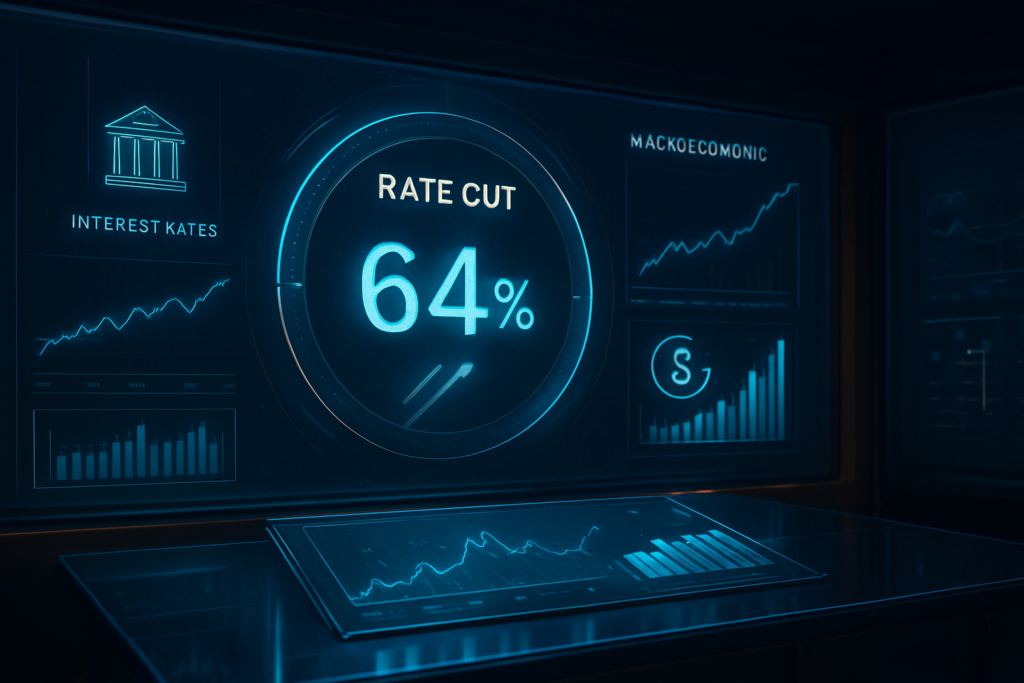
As the Federal Reserve's March 2026 meeting approaches, a striking divergence has emerged between traditional financial instruments and the burgeoning world of "Information Finance." On Kalshi, the federally regulated prediction market, traders are increasingly convinced that the central bank will pivot toward easing. Currently, 64% of participants on the platform are betting on a 25-basis-point rate cut for the March 17-18 session, a stark contrast to the more conservative stance reflected in the broader bond market.
This surge in activity is not merely speculative retail interest; it represents a fundamental shift in how macroeconomic risk is priced. With open interest on Kalshi’s Federal Reserve contracts exceeding $450 million as of February 5, 2026, these markets are no longer a sideshow. They have become a primary source of truth for hedge funds and high-frequency trading (HFT) firms, which are increasingly using these event contracts to hedge against policy shifts that traditional models often fail to capture in real-time.
The Market: What's Being Predicted
The focus of the financial world is currently fixed on the "March 2026 FOMC Target Rate" contract. Trading on Kalshi, the first CFTC-regulated prediction exchange, the market allows participants to buy "Yes" or "No" contracts on specific interest rate ranges. At the current 64% probability for a 25-basis-point cut, the price of a "Yes" contract sits at approximately $0.64, aiming for a $1.00 payout if the Fed lowers the target range from its current 3.5%–3.75% level.
This volume is part of a broader explosion in prediction market liquidity. While Kalshi leads the regulated US space with its $450 million in open interest, Polymarket—which recently re-entered the US market after acquiring a CFTC-licensed clearinghouse—is seeing similar enthusiasm, with its March rate-cut contracts trading at an even more aggressive 71% probability. The scale of these markets is now rivaling the daily turnover of mid-cap equities, providing a level of depth that allows institutional players like Jump Trading and Susquehanna Government Products to execute large-scale positions without massive slippage.
In comparison, the CME Group (NASDAQ: CME) FedWatch Tool, which derives its data from 30-Day Fed Funds Futures, is currently pricing in a much higher 90% probability that the Fed will hold rates steady. This massive 54% "spread" between prediction markets and traditional futures has created a lucrative arbitrage opportunity for algorithmic traders, who are using the Kalshi "oracle" to front-run movements in the Treasury market.
Why Traders Are Betting
The conviction among Kalshi traders is driven by a weakening labor market that has yet to be fully acknowledged by official Fed rhetoric. While Federal Reserve Chair Jerome Powell characterized economic activity as "solid" during the January 28 press conference, January’s employment data showed a significant cooling in job gains. Prediction market participants, who often prioritize "nowcasting" data over lagging government reports, are betting that the Fed will be forced to act to prevent a harder landing.
Furthermore, the "Warsh Factor" is looming large over the market. President Trump’s nomination of Kevin Warsh to succeed Powell in May 2026 has introduced a new variable. Many traders believe the current board may want to "clear the deck" with a preemptive cut before the leadership transition begins, or that they are responding to subtle political pressure for more aggressive easing. Analysts at firms like JPMorgan Chase & Co. (NYSE: JPM) and Goldman Sachs (NYSE: GS) have remained cautious in their public notes, but the "skin-in-the-game" nature of Kalshi is telling a different story.
Another factor is the rise of the "Synthetic Straddle." Institutional desks are reportedly buying "No" on a rate cut on Kalshi while simultaneously going long on interest-rate futures at the CME Group. This allows them to profit if the prediction market’s aggressive forecast proves correct, while hedging their exposure with traditional derivatives.
Broader Context and Implications
The surge in macroeconomic betting reflects the maturation of "InfoFi"—the intersection of information and finance. Major news networks have fully embraced this shift; CNBC (NASDAQ: CMCSA) recently integrated a live "Kalshi Ticker" into its daily broadcasts, acknowledging that these markets often move faster than the Bloomberg terminal in the wake of breaking news. When a probability shifts on Kalshi, it now frequently triggers multi-billion dollar trades in the S&P 500 (NYSEARCA: SPY) within milliseconds.
The entry of major infrastructure players has also lent the sector a new level of legitimacy. The Intercontinental Exchange (NYSE: ICE), the parent company of the New York Stock Exchange, recently made a landmark $2 billion investment in prediction market infrastructure. This move signals that traditional exchanges view event contracts as a permanent and essential part of the modern financial stack, rather than a fleeting trend.
However, regulatory hurdles remain. While Kalshi operates under federal oversight, Polymarket continues to face state-level challenges, including a recent temporary restraining order in Nevada. These legal battles highlight the ongoing tension between federal deregulation and state-level gaming concerns, even as the markets themselves become indispensable for risk management.
What to Watch Next
The primary catalyst for the next major movement in these odds will be the upcoming Consumer Price Index (CPI) release for January, scheduled for mid-February. If inflation continues its "sticky" trend near 2.7%, the 64% probability for a cut may retreat as traders fear the Fed will prioritize price stability over labor market support. Conversely, a sub-2.5% print could send the Kalshi odds north of 80%.
Traders should also monitor the public appearances of Fed governors over the next three weeks. Any shift in tone toward a "risk-management" approach—a common euphemism for preemptive cuts—will likely be priced into Kalshi hours before it is reflected in the CME futures.
Finally, the transition of the "Warsh nomination" through the Senate will be a key milestone. Any delays or complications in the confirmation process could inject volatility into the May and June 2026 contracts, which currently anticipate a rapid easing cycle once the new Chair takes the helm.
Bottom Line
The March 2026 FOMC meeting is shaping up to be a watershed moment for prediction markets. With $450 million at stake on Kalshi, the "wisdom of the crowd" is directly challenging the established wisdom of Wall Street’s largest banks and the CME Group’s traditional futures. The fact that 64% of traders are leaning toward a cut suggests a deeper anxiety about the labor market than official figures currently show.
What we are witnessing is the birth of a more democratic, real-time economic forecasting tool. As hedge funds and HFT bots continue to bridge the gap between prediction markets and traditional assets, the distinction between "betting" and "investing" continues to blur. Whether or not the Fed actually cuts in March, the prediction markets have already won by providing a level of transparency and responsiveness that the financial world has never seen before.
This article is for informational purposes only and does not constitute financial or betting advice. Prediction market participation may be subject to legal restrictions in your jurisdiction.
PredictStreet focuses on covering the latest developments in prediction markets.
Visit the PredictStreet website at https://www.predictstreet.ai/.