In a move that signals a tectonic shift in the relationship between artificial intelligence and the labor market, OpenAI and Walmart (NYSE: WMT) have officially launched a comprehensive AI Jobs Platform and a suite of industry-standard AI Certifications. Announced late in 2025, this partnership aims to bridge the widening "skills gap" by providing millions of workers with the tools and credentials necessary to thrive in an economy increasingly dominated by agentic workflows and automated systems.
The initiative represents the most significant private-sector effort to date to address the potential for AI-driven job displacement. By combining OpenAI’s cutting-edge Large Language Models (LLMs) with Walmart’s massive workforce and logistical infrastructure, the two giants are attempting to create a "standardized currency" for labor in the AI era. For Walmart, it is a bid to modernize its 1.6 million-strong U.S. workforce; for OpenAI, it is a strategic step toward becoming the underlying infrastructure for the future of work itself.
Technical Foundations: From Chatbots to Career Architects
The centerpiece of this collaboration is the OpenAI Jobs Platform, an AI-native recruitment and talent management ecosystem. Unlike traditional platforms like LinkedIn, which rely on keyword matching and static resumes, the new platform utilizes OpenAI’s most advanced models—widely understood to be built upon the GPT-5 architecture—to analyze a candidate’s "verified competencies." The system evaluates users through a series of hands-on "sandbox" simulations where their ability to collaborate with AI agents, solve complex logistical problems, and refine prompts is measured in real-time.
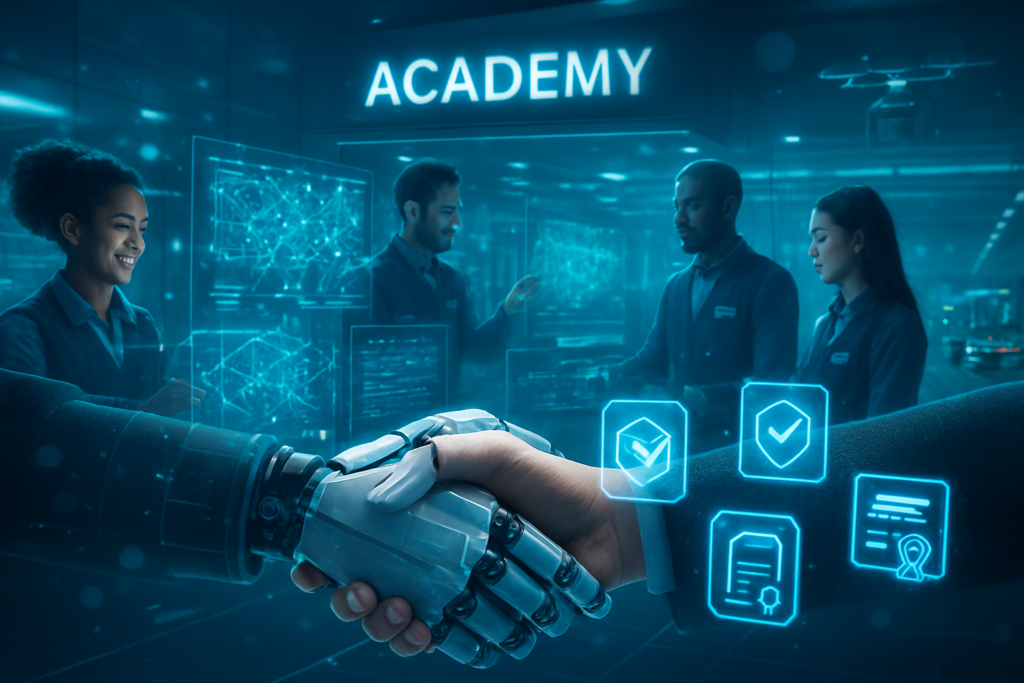
A key technical innovation is the introduction of "Study Mode" within the ChatGPT interface. This specialized environment acts as a personalized tutor, guiding workers through the new AI Certification tracks. These certifications range from "AI Foundations"—covering basic tool literacy—to advanced "Prompt Engineering" and "Retail Logic Automation." The training is adaptive, meaning the AI tutor identifies specific areas where a learner struggles and adjusts the curriculum dynamically to ensure mastery before a certification is granted.
This approach differs fundamentally from previous e-learning models. Rather than watching videos and taking multiple-choice quizzes, employees are required to build functional AI workflows within a controlled environment. Industry experts have noted that this "performance-based" certification could eventually replace the traditional college degree for many technical and operational roles, as it provides a more accurate reflection of a worker's ability to operate in a high-tech environment.
Market Disruptions: A New Front in the Tech Arms Race
The partnership has sent shockwaves through the tech and retail sectors, particularly affecting competitors like Amazon (NASDAQ: AMZN). By integrating AI training directly into the "Walmart Academy," Walmart is positioning itself as a high-tech employer of choice, potentially siphoning talent away from traditional tech hubs. Analysts at Morgan Stanley (NYSE: MS) have suggested that this move could close the digital efficiency gap between Walmart and its e-commerce rivals, as a "certified" workforce is expected to be 30-40% more productive in managing supply chains and customer interactions.
For the broader AI industry, OpenAI’s move into the jobs and certification market marks a pivot from being a software provider to becoming a labor-market regulator. By setting the standards for what constitutes "AI literacy," OpenAI is effectively defining the skill sets that will be required for the next decade. This creates a powerful moat; companies that want to hire "AI-certified" workers will naturally gravitate toward the OpenAI ecosystem, further solidifying the company's dominance over rivals like Google or Anthropic.
Startups in the HR-tech space are also feeling the heat. The vertical integration of training, certification, and job placement into a single platform threatens to disrupt a multi-billion dollar industry. Companies that previously focused on "upskilling" are now finding themselves competing with the very creators of the technology they are trying to teach, leading to a wave of consolidation as smaller players seek to find niche specializations not yet covered by the OpenAI-Walmart juggernaut.
Societal Implications and the Labor Backlash
While the tech community has largely lauded the move as a proactive solution to automation, labor advocacy groups have expressed deep-seated concerns. The AFL-CIO and other major unions have criticized the initiative as a "top-down" approach that lacks sufficient worker protections. Critics argue that by allowing a single corporation to define and certify skills, workers may become "vendor-locked" to specific AI tools, reducing their mobility and bargaining power in the long run.
There are also significant concerns regarding the "black box" nature of AI-driven hiring. If the OpenAI Jobs Platform uses proprietary algorithms to match workers with roles, there are fears that existing biases could be baked into the system, leading to systemic exclusion under the guise of "objective" data. The California Federation of Labor Unions has already called for legislative oversight to ensure that these AI certifications are transparent and that the data collected during the "Study Mode" training is not used to penalize or surveil employees.
Despite these concerns, the broader AI landscape is moving toward this model of "agentic commerce." The idea that a worker is not just a manual laborer but a "manager of agents" is becoming the new standard. This shift mirrors previous industrial milestones, such as the introduction of the assembly line or the personal computer, but at a velocity that is unprecedented. The success or failure of this partnership will likely serve as a blueprint for how other Fortune 500 companies handle the transition to an AI-first economy.
The Horizon: What Lies Ahead for the AI Workforce
Looking forward, OpenAI has set an ambitious goal to certify 10 million Americans by 2030. In the near term, we can expect the Jobs Platform to expand beyond Walmart to include other major retailers and eventually government agencies. There are already rumors of a "Public Sector Track" designed to help modernize local bureaucracies through AI-certified administrative staff. As the technology matures, we may see the emergence of "Micro-Certifications"—highly specific credentials for niche tasks that can be earned in hours rather than weeks.
The long-term challenge will be the "half-life" of these skills. In an era where AI models are updated every few months, a certification earned today might be obsolete by next year. Experts predict that the future of work will involve "continuous certification," where workers are constantly in a state of learning, guided by their AI tutors. This will require a fundamental rethinking of the work-week, potentially leading to a model where a portion of every employee's day is dedicated solely to AI-led skill maintenance.
Final Assessment: A Turning Point in Human-AI Collaboration
The partnership between OpenAI and Walmart is more than just a corporate training program; it is a bold experiment in social engineering. By attempting to standardize AI education at scale, these companies are laying the groundwork for a new social contract in the age of automation. Whether this leads to a more empowered, highly-skilled workforce or a new form of corporate dependency remains to be seen, but the significance of this moment cannot be overstated.
As we move into 2026, the industry will be watching the pilot results from Walmart’s 1.6 million associates with intense scrutiny. If the platform successfully transitions these workers into higher-value roles, it will be remembered as the moment the "AI revolution" finally became inclusive of the broader workforce. For now, the message is clear: the era of the "AI-augmented worker" has arrived, and the race to define that role is officially on.
This content is intended for informational purposes only and represents analysis of current AI developments.
TokenRing AI delivers enterprise-grade solutions for multi-agent AI workflow orchestration, AI-powered development tools, and seamless remote collaboration platforms.
For more information, visit https://www.tokenring.ai/.