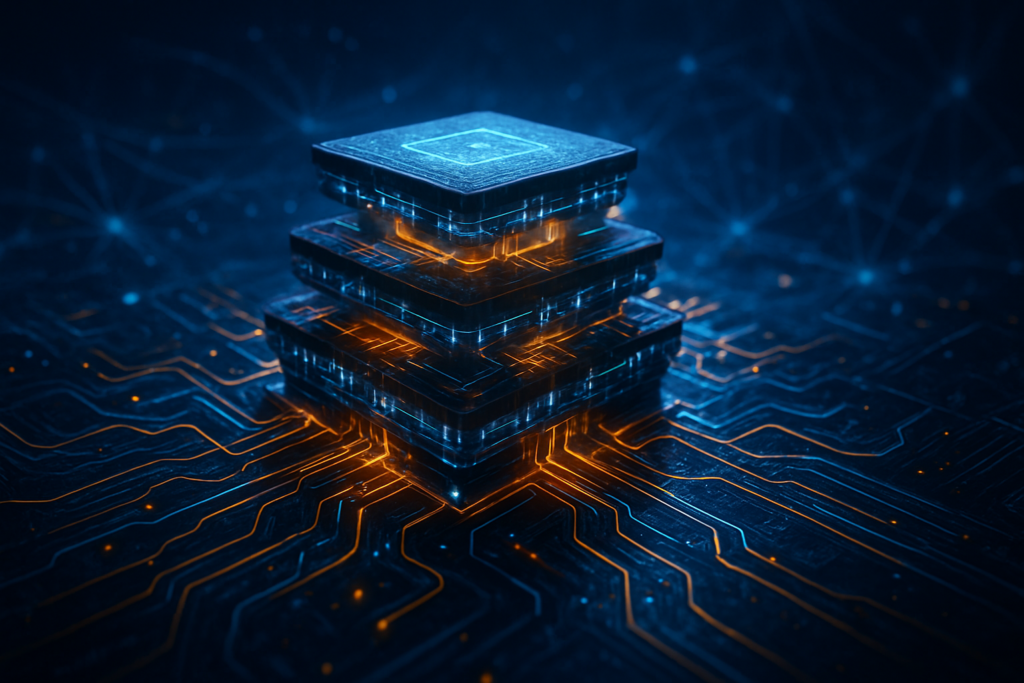
As of early 2026, the semiconductor industry has reached a definitive turning point. The traditional method of carving massive, single-piece "monolithic" processors from silicon wafers has hit a physical and economic wall. In its place, a new era of "heterogeneous integration"—popularly known as the Chiplet Revolution—is now the primary engine keeping Moore’s Law alive. By "stitching" together smaller, specialized silicon dies using advanced 2.5D and 3D packaging, industry titans are building processors that are effectively 12 times the size of traditional designs, providing the raw transistor counts necessary to power the next generation of 2026-era AI models.
This shift represents more than just a manufacturing tweak; it is a fundamental reimagining of computer architecture. Companies like Intel (NASDAQ: INTC) and AMD (NASDAQ: AMD) are no longer just chip makers—they are becoming master architects of "systems-on-package." This modular approach allows for higher yields, lower production costs, and the ability to mix and match different process nodes within a single device. As AI models move toward multi-trillion parameter scales, the ability to scale silicon beyond the "reticle limit" (the physical size limit of a single chip) has become the most critical competitive advantage in the global tech race.
Breaking the Reticle Limit: The Tech Behind the Stitch
The technical cornerstone of this revolution lies in advanced packaging technologies like Intel’s Foveros and EMIB (Embedded Multi-die Interconnect Bridge). In early 2026, Intel has successfully transitioned to high-volume manufacturing on its 18A (1.8nm-class) node, utilizing these techniques to create the "Clearwater Forest" Xeon processors. By using Foveros Direct 3D, Intel can stack compute tiles directly onto an active base die with a 9-micrometer copper-to-copper bump pitch. This provides a tenfold increase in interconnect density compared to the solder-based stacking of just a few years ago. This "3D fabric" allows data to move between specialized chiplets with almost the same speed and efficiency as if they were on a single piece of silicon.
AMD has taken a similar lead with its Instinct MI400 series, which utilizes the CDNA 5 architecture. By leveraging TSMC (NYSE: TSM) and its CoWoS (Chip-on-Wafer-on-Substrate) packaging, AMD has moved away from the thermodynamic limitations of monolithic chips. The MI400 is a marvel of heterogeneous integration, combining high-performance logic tiles with a massive 432GB of HBM4 memory, delivering a staggering 19.6 TB/s of bandwidth. This modularity allows AMD to achieve a 33% lower Total Cost of Ownership (TCO) compared to equivalent monolithic designs, as smaller dies are significantly easier to manufacture without defects.
Industry experts and AI researchers have hailed this transition as the "Lego-ification" of silicon. Previously, a single defect on a massive 800mm² AI chip would render the entire unit useless. Today, if a single chiplet is defective, it is simply discarded before being integrated into the final package, dramatically boosting yields. Furthermore, the Universal Chiplet Interconnect Express (UCIe) standard has matured, allowing for a multi-vendor ecosystem where an AI company could theoretically pair an Intel compute tile with a specialized networking tile from a startup, all within the same physical package.
The Competitive Landscape: A Battle for Silicon Sovereignty
The shift to chiplets has reshaped the power dynamics among tech giants. While NVIDIA (NASDAQ: NVDA) remains the dominant force with an estimated 80-90% of the data center AI market, its competitors are using chiplet architectures to chip away at its lead. NVIDIA’s upcoming Rubin architecture is expected to lean even more heavily into advanced packaging to maintain its performance edge. However, the modular nature of chiplets has allowed companies like Microsoft (NASDAQ: MSFT), Meta (NASDAQ: META), and Google (NASDAQ: GOOGL) to develop their own custom AI ASICs (Application-Specific Integrated Circuits) more efficiently, reducing their total reliance on NVIDIA’s premium-priced full-stack systems.
For Intel, the chiplet revolution is a path to foundry leadership. By offering its 18A and 14A nodes to external customers through Intel Foundry, the company is positioning itself as the "Western alternative" to TSMC. This has profound implications for AI startups and defense contractors who require domestic manufacturing for "Sovereign AI" initiatives. In the U.S., the successful ramp-up of 18A production at Fab 52 in Arizona is seen as a major victory for the CHIPS Act, providing a high-volume, leading-edge manufacturing base that is geographically decoupled from the geopolitical tensions surrounding Taiwan.
Meanwhile, the battle for advanced packaging capacity has become the new industry bottleneck. TSMC has tripled its CoWoS capacity since 2024, yet demand from NVIDIA and AMD continues to outstrip supply. This scarcity has turned packaging into a strategic asset; companies that secure "slots" in advanced packaging facilities are the ones that will define the AI landscape in 2026. The strategic advantage has shifted from who has the best design to who has the best "integration" capabilities.
Scaling Laws and the Energy Imperative
The wider significance of the chiplet revolution extends into the very "scaling laws" that govern AI development. For years, the industry assumed that model performance would scale simply by adding more data and more compute. However, as power consumption for a single AI rack approaches 100kW, the focus has shifted to energy efficiency. Heterogeneous integration allows engineers to place high-bandwidth memory (HBM) mere millimeters away from the processing cores, drastically reducing the energy required to move data—the most power-hungry part of AI training.
This development also addresses the growing concern over the environmental impact of AI. By using "active base dies" and backside power delivery (like Intel’s PowerVia), 2026-era chips are significantly more power-efficient than their 2023 predecessors. This efficiency is what makes the deployment of trillion-parameter models economically viable for enterprise applications. Without the thermal and power advantages of chiplets, the "AI Summer" might have cooled under the weight of unsustainable electricity costs.
However, the move to chiplets is not without its risks. The complexity of testing and validating a system composed of multiple dies is exponentially higher than a monolithic chip. There are also concerns regarding the "interconnect tax"—the overhead required to manage communication between chiplets. While standards like UCIe 3.0 have mitigated this, the industry is still learning how to optimize software for these increasingly fragmented hardware layouts.
The Road to 2030: Optical Interconnects and AI-Designed Silicon
Looking ahead, the next frontier of the chiplet revolution is Silicon Photonics. As electrical signals over copper wires hit physical speed limits, the industry is moving toward "Co-Packaged Optics" (CPO). By 2027, experts predict that chiplets will communicate using light (lasers) instead of electricity, potentially reducing networking power consumption by another 40%. This will enable "rack-scale" computers where thousands of chiplets across different boards act as a single, massive unified processor.
Furthermore, the design of these complex chiplet layouts is increasingly being handled by AI itself. Tools from Synopsys (NASDAQ: SNPS) and Cadence (NASDAQ: CDNS) are now using reinforcement learning to optimize the placement of billions of transistors and the routing of interconnects. This "AI-designing-AI-hardware" loop is expected to shorten the development cycle for new chips from years to months, leading to a hyper-fragmentation of the market where specialized silicon is built for specific niches, such as real-time medical diagnostics or autonomous swarm robotics.
A New Chapter in Computing History
The transition from monolithic to chiplet-based architectures will likely be remembered as one of the most significant milestones in the history of computing. It has effectively bypassed the physical limits of the "reticle limit" and provided a sustainable path forward for AI scaling. By early 2026, the results are clear: chips are getting larger, more complex, and more specialized, yet they are becoming more cost-effective to produce.
As we move further into 2026, the key metrics to watch will be the yield stability of Intel’s 18A node and the adoption rate of the UCIe standard among third-party chiplet designers. The "Chiplet Revolution" has ensured that the hardware will not be the bottleneck for AI progress. Instead, the challenge now shifts to the software and algorithmic fronts—figuring out how to best utilize the massive, heterogeneous processing power that is now being "stitched" together in the world's most advanced fabrication plants.
This content is intended for informational purposes only and represents analysis of current AI developments.
TokenRing AI delivers enterprise-grade solutions for multi-agent AI workflow orchestration, AI-powered development tools, and seamless remote collaboration platforms.
For more information, visit https://www.tokenring.ai/.