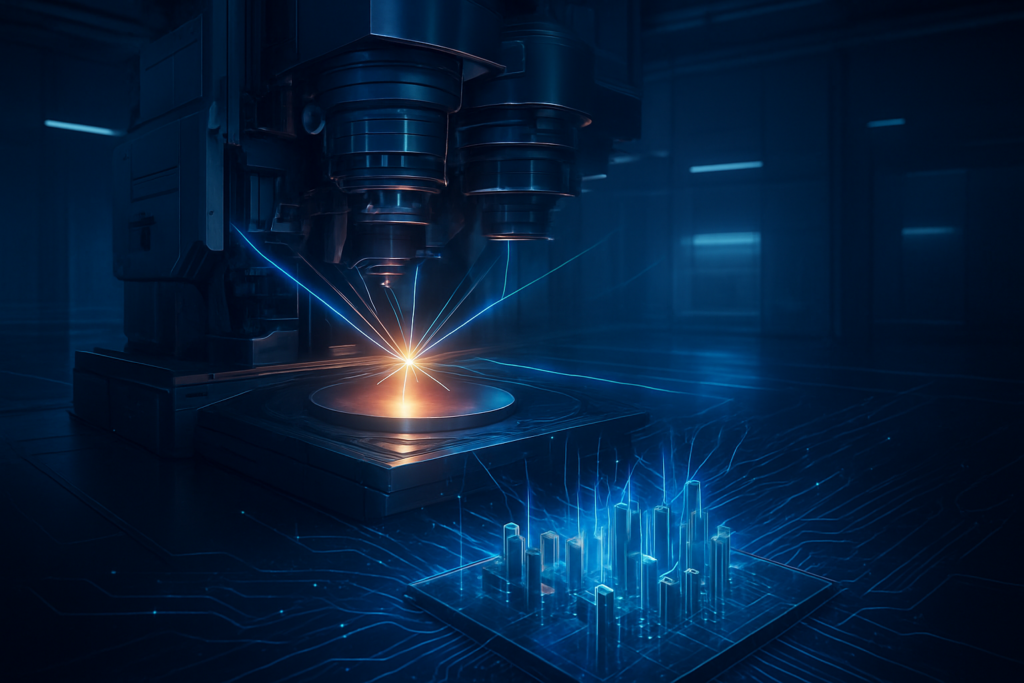
As of January 2026, the global race for semiconductor supremacy has reached a fever pitch, centered on a massive, truck-sized machine that costs more than a fleet of private jets. ASML (NASDAQ: ASML) has officially transitioned its "High-NA" (High Numerical Aperture) Extreme Ultraviolet (EUV) lithography systems into high-volume manufacturing, marking the most significant shift in silicon fabrication in over a decade. While the industry grapples with the staggering $350 million to $400 million price tag per unit, Intel (NASDAQ: INTC) has emerged as the aggressive vanguard, betting its entire "IDM 2.0" turnaround strategy on being the first to operationalize these tools for the next generation of "Angstrom-class" processors.
The transition to High-NA EUV is not merely a technical upgrade; it is a fundamental reconfiguration of how the world's most advanced AI chips are built. By enabling higher-resolution circuitry, these machines allow for the creation of transistors so small they are measured in Angstroms (tenths of a nanometer). For an industry currently hitting the physical limits of traditional EUV, this development is the "make or break" moment for the continuation of Moore’s Law and the sustained growth of generative AI compute.
Technical Specifications and the Shift from Multi-Patterning
The technical heart of this revolution lies in the ASML Twinscan EXE:5200B. Unlike standard EUV machines, which utilize a 0.33 Numerical Aperture (NA) lens, the High-NA systems feature a 0.55 NA projection optics system. This allows for a 1.7x increase in feature density and a resolution of roughly 8nm, compared to the 13.5nm limit of previous generations. In practical terms, this means semiconductor engineers can print features that are nearly twice as small without resorting to complex "multi-patterning"—a process that involves passing a wafer through a machine multiple times to achieve a single layer of circuitry.
By moving back to "single-exposure" lithography at smaller scales, manufacturers can significantly reduce the number of process steps—from roughly 40 down to fewer than 10 for critical layers. This not only simplifies production but also theoretically improves yield and reduces the potential for manufacturing defects. The EXE:5200B also boasts an impressive throughput of 175 to 200 wafers per hour, a necessity for the high-volume demands of modern data center demand. Initial reactions from the research community have been one of cautious awe; while the precision—reaching a 0.7nm overlay accuracy—is unprecedented, the logistical challenge of installing these 150-ton machines has required Intel and others to literally raise the ceilings of their existing fabrication plants.
Competitive Implications: Intel, TSMC, and the Foundry War
The competitive landscape of the foundry market has been fractured by this development. Intel (NASDAQ: INTC) has secured the lion's share of ASML’s early output, installing a fleet of High-NA tools at its D1X facility in Oregon and its new fabs in Arizona. This first-mover advantage is aimed squarely at its "Intel 14A" (1.4nm) node, which is slated for pilot production in early 2027. By being the first to master the learning curve of High-NA, Intel hopes to reclaim the manufacturing crown it lost to TSMC (NYSE: TSM) nearly a decade ago.
In contrast, TSMC has adopted a more conservative "wait-and-see" approach. The Taiwanese giant has publicly stated that it can achieve its upcoming A16 and A14 nodes using existing Low-NA multi-patterning techniques, arguing that the $400 million cost of High-NA is not yet economically justified for its customers. This creates a high-stakes divergence: if Intel successfully scales High-NA and delivers the 15–20% performance-per-watt gains promised by its 14A node, it could lure away marquee AI customers like NVIDIA (NASDAQ: NVDA) and Apple (NASDAQ: AAPL) who are currently tethered to TSMC. Samsung (KRX: 005930), meanwhile, is playing the middle ground, integrating High-NA into its 2nm lines to attract "anchor tenants" for its new Texas-based facilities.
Broader Significance for the AI Landscape
The wider significance of High-NA EUV extends into the very architecture of artificial intelligence. As of early 2026, the demand for denser, more energy-efficient chips is driven almost entirely by the massive power requirements of Large Language Models (LLMs). High-NA lithography enables the production of chips that consume 25–35% less power while offering nearly 3x the transistor density of current standards. This is the "essential infrastructure" required for the next phase of the AI revolution, where trillions of parameters must be processed locally on edge devices rather than just in massive, energy-hungry data centers.
However, the astronomical cost of these machines raises concerns about the further consolidation of the semiconductor industry. With only three companies in the world currently capable of even considering a High-NA purchase, the barrier to entry for potential competitors has become effectively insurmountable. This concentration of manufacturing power could lead to higher chip prices for downstream AI startups, potentially slowing the democratization of AI technology. Furthermore, the reliance on a single source—ASML—for this equipment remains a significant geopolitical bottleneck, as any disruption to the Netherlands-based supply chain could stall global technological progress for years.
Future Developments and Sub-Nanometer Horizons
Looking ahead, the industry is already eyeing the horizon beyond the EXE:5200B. While Intel focuses on ramping up its 14A node throughout 2026 and 2027, ASML is reportedly already in the early stages of researching "Hyper-NA" lithography, which would push numerical aperture even higher to reach sub-1nm scales. Near-term, the industry will be watching Intel's yield rates on its 18A and 14A processes; if Intel can prove that High-NA leads to a lower total cost of ownership through process simplification, TSMC may be forced to accelerate its own adoption timeline.
The next 18 months will also see the emergence of "High-NA-native" chip designs. Experts predict that NVIDIA and other AI heavyweights will begin releasing blueprints for NPUs (Neural Processing Units) that take advantage of the specific layout efficiencies of single-exposure High-NA. The challenge will be software-hardware co-design: ensuring that the massive increase in transistor counts can be effectively utilized by AI algorithms without running into "dark silicon" problems where parts of the chip must remain powered off to prevent overheating.
Summary and Final Thoughts
In summary, the arrival of High-NA EUV lithography marks a transformative chapter in the history of computing. Intel’s aggressive adoption of ASML’s $350 million machines is a bold gamble that could either restore the company to its former glory or become a cautionary tale of over-capitalization. Regardless of the outcome for individual companies, the technology itself ensures that the path toward Angstrom-scale computing is now wide open, providing the hardware foundation necessary for the next decade of AI breakthroughs.
As we move deeper into 2026, the industry will be hyper-focused on the shipment volumes of the EXE:5200 series and the first performance benchmarks from Intel’s High-NA-validated 18AP node. The silicon wars have entered a new dimension—one where the smallest of measurements carries the largest of consequences for the future of global technology.
This content is intended for informational purposes only and represents analysis of current AI developments.
TokenRing AI delivers enterprise-grade solutions for multi-agent AI workflow orchestration, AI-powered development tools, and seamless remote collaboration platforms.
For more information, visit https://www.tokenring.ai/.