In a move that resets the competitive landscape for the next half-decade, NVIDIA (NASDAQ: NVDA) has officially unveiled the "Vera Rubin" platform, a comprehensive architectural overhaul designed specifically for the era of agentic AI and trillion-parameter models. Unveiled at the start of 2026, the platform represents a transition from discrete GPU acceleration to what NVIDIA CEO Jensen Huang describes as a "six-chip symphony," where the CPU, GPU, DPU, and networking fabric operate as a single, unified supercomputer at the rack scale.
The immediate significance of the Vera Rubin architecture lies in its radical efficiency. By optimizing the entire data path—from the memory cells of the new Vera CPU to the 4-bit floating point (NVFP4) math in the Rubin GPU—NVIDIA has achieved a staggering 10-fold reduction in the cost of AI inference compared to the previous-generation Blackwell chips. This breakthrough arrives at a critical juncture as the industry shifts away from simple chatbots toward autonomous "AI agents" that require continuous, high-speed reasoning and massive context windows, capabilities that were previously cost-prohibitive.
Technical Deep Dive: The Six-Chip Architecture and NVFP4
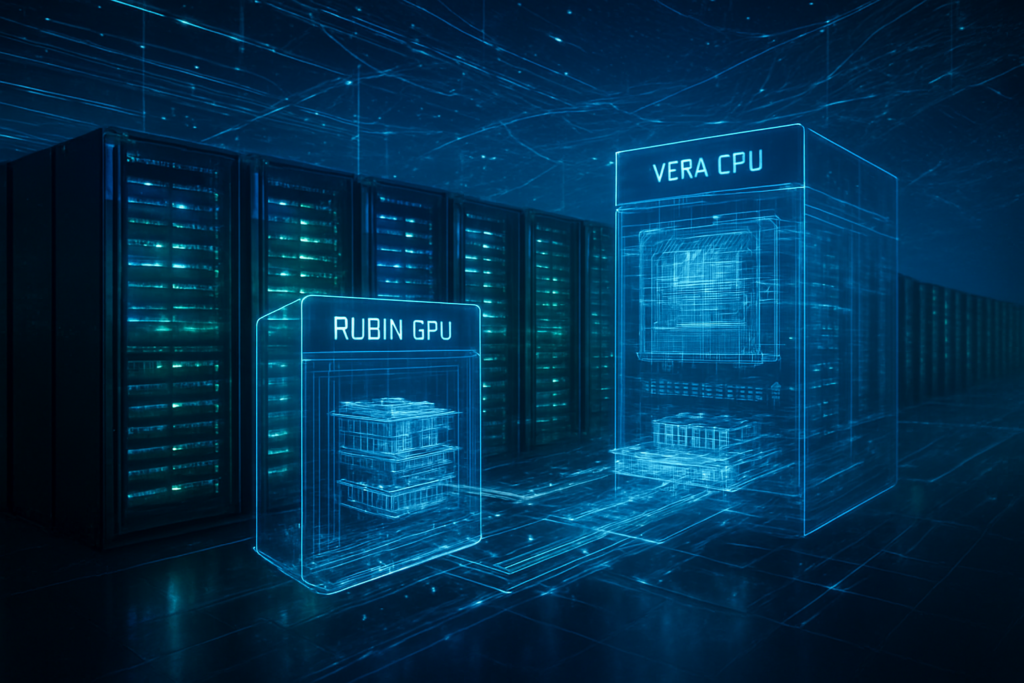
At the heart of the platform is the Rubin R200 GPU, built on an advanced 3nm process that packs 336 billion transistors into a dual-die configuration. Rubin is the first architecture to fully integrate HBM4 memory, utilizing 288GB of high-bandwidth memory per GPU and delivering 22 TB/s of bandwidth—nearly triple that of Blackwell. Complementing the GPU is the Vera CPU, featuring custom "Olympus" ARM-based cores. Unlike its predecessor, Grace, the Vera CPU is optimized for spatial multithreading, allowing it to handle 176 concurrent threads to manage the complex branching logic required for agentic AI. The Vera CPU operates at a remarkably low 50W, ensuring that the bulk of a data center’s power budget is reserved for the Rubin GPUs.
The technical secret to the 10x cost reduction is the introduction of the NVFP4 format and hardware-accelerated adaptive compression. NVFP4 (4-bit floating point) allows for massive throughput by using a two-tier scaling mechanism that maintains near-BF16 accuracy despite the lower precision. When combined with the new BlueField-4 DPU, which features a dedicated Context Memory Storage Platform, the system can share "Key-Value (KV) cache" data across an entire rack. This eliminates the need for GPUs to re-process identical context data during multi-turn conversations, a massive efficiency gain for enterprise AI agents.
The flagship physical manifestation of this technology is the NVL72 rack-scale system. Utilizing the 6th-generation NVLink Switch, the NVL72 unifies 72 Rubin GPUs and 36 Vera CPUs into a single logical entity. The system provides an aggregate bandwidth of 260 TB/s—exceeding the total bandwidth of the public internet as of 2026. Fully liquid-cooled and built on a cable-free modular tray design, the NVL72 is designed for the "AI Factories" of the future, where thousands of racks are networked together to form a singular, planetary-scale compute fabric.
Market Implications: Microsoft's Fairwater Advantage
The announcement has sent shockwaves through the hyperscale community, with Microsoft (NASDAQ: MSFT) emerging as the primary beneficiary through its "Fairwater" superfactory initiative. Microsoft has specifically engineered its new data center sites in Wisconsin and Atlanta to accommodate the thermal and power densities of the Rubin NVL72 racks. By integrating these systems into a unified "AI WAN" backbone, Microsoft aims to offer the lowest-cost inference in the cloud, potentially forcing competitors like Amazon (NASDAQ: AMZN) and Alphabet (NASDAQ: GOOGL) to accelerate their own custom silicon roadmaps.
For the broader AI ecosystem, the 10x reduction in inference costs lowers the barrier to entry for startups and enterprises. High-performance reasoning models, once the exclusive domain of tech giants, will likely become commoditized, shifting the competitive battleground from "who has the most compute" to "who has the best data and agentic workflows." However, this development also poses a significant threat to rival chipmakers like AMD (NASDAQ: AMD) and Intel (NASDAQ: INTEL), who are now tasked with matching NVIDIA’s rack-scale integration rather than just competing on raw GPU specifications.
A New Benchmark for the Agentic AI Era
The Vera Rubin platform marks a departure from the "Moore's Law" approach of simply adding more transistors. Instead, it reflects a shift toward "System-on-a-Rack" engineering. This evolution mirrors previous milestones like the introduction of the CUDA platform in 2006, but on a much grander scale. By solving the "memory wall" through HBM4 and the "connectivity wall" through NVLink 6, NVIDIA is addressing the primary bottlenecks that have limited the autonomy of AI agents.
While the technical achievements are significant, the environmental and economic implications are equally profound. The 10x efficiency gain is expected to dampen the skyrocketing energy demands of AI data centers, though critics argue that the lower cost will simply lead to a massive increase in total usage—a classic example of Jevons Paradox. Furthermore, the reliance on advanced 3nm processes and HBM4 creates a highly concentrated supply chain, raising concerns about geopolitical stability and the resilience of AI infrastructure.
The Road Ahead: Deployment and Scaling
Looking toward the second half of 2026, the focus will shift from architectural theory to real-world deployment. The first Rubin-powered clusters are expected to come online in Microsoft’s Fairwater facilities by Q3 2026, with other cloud providers following shortly thereafter. The industry is closely watching the rollout of "Software-Defined AI Factories," where NVIDIA’s NIM (NVIDIA Inference Microservices) will be natively integrated into the Rubin hardware, allowing for "one-click" deployment of autonomous agents across entire data centers.
The primary challenge remains the manufacturing yield of such complex, multi-die chips and the global supply of HBM4 memory. Analysts predict that while NVIDIA has secured the lion's share of HBM4 capacity, any disruption in the supply chain could lead to a bottleneck for the broader AI market. Nevertheless, the Vera Rubin platform has set a new high-water mark for what is possible in silicon, paving the way for AI systems that can reason, plan, and execute tasks with human-like persistence.
Conclusion: The Era of the AI Factory
NVIDIA’s Vera Rubin platform is more than just a seasonal update; it is a foundational shift in how the world builds and scales intelligence. By delivering a 10x reduction in inference costs and pioneering a unified rack-scale architecture, NVIDIA has reinforced its position as the indispensable architect of the AI era. The integration with Microsoft's Fairwater superfactories underscores a new level of partnership between hardware designers and cloud operators, signaling the birth of the "AI Power Utility."
As we move through 2026, the industry will be watching for the first benchmarks of Rubin-trained models and the impact of NVFP4 on model accuracy. If NVIDIA can deliver on its promises of efficiency and performance, the Vera Rubin platform may well be remembered as the moment when artificial intelligence transitioned from a tool into a ubiquitous, cost-effective utility that powers every facet of the global economy.
This content is intended for informational purposes only and represents analysis of current AI developments.
TokenRing AI delivers enterprise-grade solutions for multi-agent AI workflow orchestration, AI-powered development tools, and seamless remote collaboration platforms.
For more information, visit https://www.tokenring.ai/.